
- Home
- Country
- Face Value
- Metal
- Period
- 1795 - 1900 (100)
- 17th Century (5)
- 18th Century (2)
- 1901 - 1999 (72)
- 1930s (3)
- 1940s (3)
- 1970s (2)
- 19th Century (9)
- 20th Century (11)
- After 2000 (10)
- Before 1800 (2)
- Feudal Coinage (2)
- Feudal Currency (21)
- Francs 1962 - 1997 (2)
- Imperial 96 - 235 Ad (29)
- Old Francs 20th (2)
- Old Francs Xxth (3)
- Republic 300 - 27 Bc (10)
- Royal Coinage (33)
- Royal Currency (123)
- Other (4415)
- Region
- Type
- 10 Zlotych (2)
- 20 Francs (2)
- 5 Francs (3)
- 5 Points (4)
- Book, Work (9)
- Chips (3)
- Coin (24)
- Essai (4)
- Foreign Medals (7)
- French Medals (34)
- Jetons (63)
- Livre, Ouvrage (7)
- Medal (9)
- Monnaie De Paris (45)
- Médaille (2)
- Paris Mint (16)
- Royal (2)
- School Poster (6)
- Tokens (88)
- Écu D'or Au Soleil (2)
- Other (4527)
Bituriges Cubes bronze Abudos, weight 2.53 g, superb condition, very rare
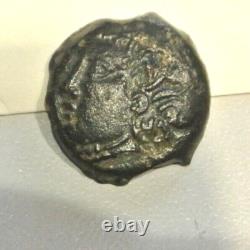
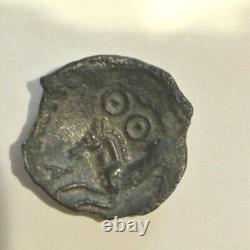

The Bituriges Cubes were one of the most powerful peoples of Celtic Gaul. Their territory extended over part of Bourbonnais, Touraine, and Berry, corresponding to the modern-day departments of Cher, Indre, and part of Allier. Their capital was the oppidum of Avaricum (Bourges). The Loire River separated them from the Aedui and the Carnutes. Their neighbors also included the Pictones, the Lemovices, and the Arverni.
According to Livy’s account, the Bituriges king Ambigatus is said to have ruled over all of unified Gaul in the 6th century BC and to have sent his two nephews, Bellovesus and Sigovesus, one to Italy and the other to the East, to found the Gallic Empire, which a century later extended over Great Britain, central Europe (except Switzerland), northern Italy, and most of the Danube region. Before the Gallic War, the Bituriges are said to have been clients of the Aedui, and a contingent of Boii had been settled on their territory. Their main wealth came from livestock breeding and iron mines, which brought them prosperity and affluence. In 52 BC, they were defeated at Genabum (Orléans) by Caesar. Vercingetorix urged them to adopt scorched-earth tactics.
They destroyed more than twenty oppida, but refused to do the same to their capital, Avaricum (Bourges). Caesar came to besiege the oppidum, defended by thirty thousand Bituriges and ten thousand allies.
The city was taken and burned; only eight hundred soldiers managed to escape, while the garrison and the population were massacred. Caesar found abundant supplies there, which allowed him to spend the winter and prepare the campaign for the following spring. Nevertheless, the Bituriges are said to have still provided a contingent of twelve thousand men to the Gallic coalition’s relief army during the siege of Alesia. At the beginning of 51 BC, Caesar led a new campaign against the Bituriges, who submitted very quickly.
A few weeks later, they appealed to Caesar for help in fighting the Carnutes. I, 18; VII, 5, 8, 9, 11–13, 15, 21, 29, 75, 90; VIII, 2, 3, 4, 11. Kruta: 68–70, 145, 186–187, 212–213, 240, 334, 344, 360.