
- Home
- Face Value
- Figure
- Metal
- Period
- 1795 - 1900 (99)
- 17th Century (5)
- 18th Century (2)
- 1901 - 1999 (71)
- 1930s (3)
- 1940s (3)
- 1970s (2)
- 19th Century (9)
- 20th Century (8)
- After 2000 (10)
- Before 1800 (2)
- Feudal Coinage (2)
- Feudal Currency (21)
- Francs 1962 - 1997 (2)
- Imperial 96 - 235 Ad (29)
- Old Francs 20th (2)
- Old Francs Xxth (3)
- Republic 300 - 27 Bc (10)
- Royal Coinage (31)
- Royal Currency (123)
- Other (4410)
- Quality
- Royal Era
Diocletian, Aureus, 284-294, Rome, Very rare, Gold, SUP, RIC146
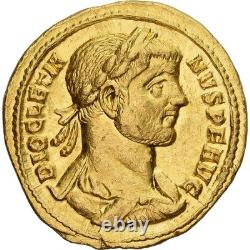
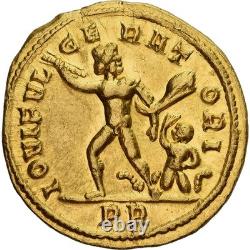


Bust of Diocletian, laureate, draped, and cuirassed, facing right. Jupiter standing left, head turned back, hurling a thunderbolt at a kneeling Titan/Giant. An example of superb quality, on a very broad flan, with part of its mint luster still visible. Slight circulation wear on the portrait’s beard, otherwise extremely well preserved. The reverse is also splendidly rendered, with a striking mythological scene: Zeus striking with lightning a giant with eel- or serpent-like legs, who is none other than Porphyrion, the “king of the giants,” or the “greatest of the giants.
” From Greek mythology, this giant was one of the main actors in the Gigantomachy, the battle between the gods of Olympus and the Giants. Here he is shown kneeling, defeated by Zeus and being finished off by the thunderbolts of the king of the Gods. According to legend, Eros, who thought to kill him with one of his arrows (or Zeus himself), prompts him to attack Hera and tear her robe.
This provokes Zeus’s intervention, who strikes him with his thunderbolt, and the giant is then finished off by a poisoned arrow from Heracles. Perhaps this should be seen as an instrument of imperial propaganda introduced by Diocletian, then Augustus and head of the western part of the Roman Empire, associating himself with the king of the Gods and, perhaps through this mythological scene, associating his enemies (notably the usurper Carausius in Gaul and Roman Britain) with the giant Porphyrion being struck down by the gods, a sign of a future victory over the one who had usurped the imperial throne.
Cohen 285; Calicó 4531 (these dies). DIOCLETIA - NVS P F AVG, IOVI FVL - GE - RAT - ORI // PR.